
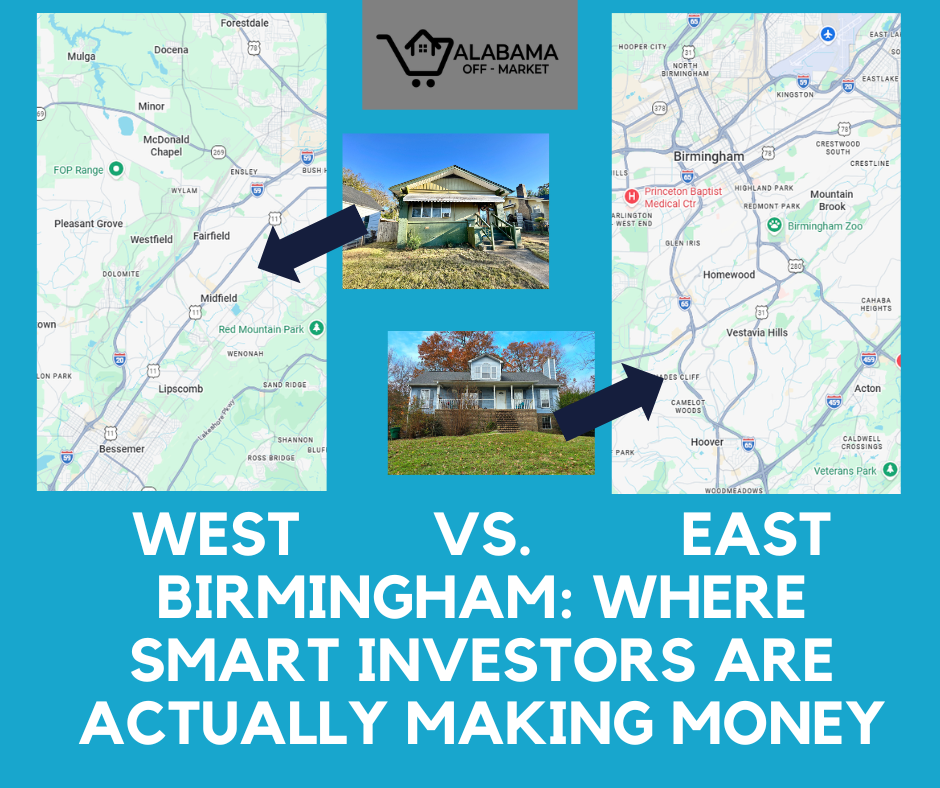
If you’ve been searching for Birmingham investment neighborhoods, you’ve probably noticed something interesting: everyone talks about Hoover, Vestavia Hills, and Pelham—but the deals you’re actually seeing? They’re mostly in western Birmingham.
Here’s the truth that most wholesalers won’t tell you: the best investment neighborhoods in Birmingham aren’t always where you think they are. And understanding the real numbers behind East vs. West Birmingham could be the difference between a 15% ROI and a 35% ROI.
I grew up in Birmingham, and I’ve been sourcing off-market deals across every neighborhood from Ensley to Vestavia for years. In this article, I’m breaking down the actual data—median home prices, rental rates, days on market, and cash-on-cash returns—so you can make informed decisions about where to invest your capital in 2026.
The Birmingham Investment Landscape: What the Data Actually Shows
Let’s start with the numbers that matter. As of early 2026, here’s what the Birmingham metro market looks like:
Overall Birmingham Market:
- Median home sale price: $164,900
- Median rent: $1,295/month
- Average days on market: 34 days
- Year-over-year price change: +0.5%
But here’s where it gets interesting—these citywide averages mask massive disparities between East and West Birmingham neighborhoods.
East Birmingham: The Premium Play (Hoover, Vestavia, Pelham)
The Numbers
Hoover:
- Median sale price: $429,000 (up 6.3% YoY)
- Price per square foot: $180
- Median days on market: 67 days
- Typical rental range: $1,800-$2,500+/month
Vestavia Hills:
- Median home value: $659,000
- Premium school district appeal
- Lower inventory, higher competition
- Rental demand from families seeking top-rated schools
Pelham:
- Median sale price: $389,000
- Growing suburb with newer construction
- Strong appreciation potential
- Rental range: $1,100-$2,400/month
The Reality for Investors
Here’s what I tell out-of-state investors who call me asking about Hoover and Vestavia: these are phenomenal neighborhoods, but they’re tough markets for the $50K-$250K investor.
Why East Birmingham is challenging:
- High entry costs – At $429K median in Hoover, you’re looking at $85K+ down payments for traditional financing
- Longer hold times – 67 days on market means slower flips and higher carrying costs
- Thinner margins – Premium neighborhoods = premium renovation expectations = higher rehab costs
- Limited distressed inventory – Motivated sellers in these areas are rare; most deals are retail
When East Birmingham makes sense:
- You have $100K+ in capital to deploy
- You’re targeting high-end buy-and-hold with $2,000+ rents
- You can wait 60-90 days for the right buyer
- You want long-term appreciation over immediate cash flow
In my experience, successful East Birmingham investors are typically doing BRRRR strategies (Buy, Rehab, Rent, Refinance, Repeat) or targeting luxury flips with $75K+ renovation budgets.
West Birmingham: Where the Cash Flow Actually Is
Now let’s talk about where most of the actual deals are happening in 2026.
The Numbers
West Birmingham Neighborhoods (Ensley, Ensley Highlands, Arlington-West End):
- Average rental rates: $700-$1,500/month
- Median home prices: $50K-$120K (significantly below city average)
- Days on market: 20-30 days (faster than East Birmingham)
- Higher volume of distressed/motivated seller properties
The Reality for Investors
This is where I source most of my wholesale deals, and here’s why smart investors are paying attention:
The West Birmingham Advantage:
- Low entry barriers – $50K-$120K purchase prices mean you can get started with $10K-$25K down
- Higher cash-on-cash returns – Even at $750/month rent, you’re looking at 12-20% returns
- Volume of deals – More motivated sellers = more negotiating power
- Faster exits – Properties move in 20-30 days when priced right
Example Deal Breakdown (Real Numbers):
West Birmingham 3BR/1BA:
- Purchase price: $65,000
- Rehab budget: $25,000
- All-in cost: $90,000
- ARV: $115,000-$125,000
- Monthly rent: $850
- Annual cash flow: $4,800-$6,000
- Cash-on-cash return: 18-22%
Compare to East Birmingham 3BR/2BA:
- Purchase price: $350,000
- Rehab budget: $50,000
- All-in cost: $400,000
- ARV: $450,000-$475,000
- Monthly rent: $2,200
- Annual cash flow: $8,000-$10,000
- Cash-on-cash return: 10-12%
The Challenges You Need to Know
I’m not going to sugarcoat it—West Birmingham investing isn’t for everyone. Here are the real challenges:
Property management intensity:
- Higher tenant turnover (expect 18-24 month average tenancy vs. 3-5 years in East Birmingham)
- More maintenance calls
- Need for experienced property management or strong local partnerships
Neighborhood perception:
- Harder to attract out-of-state buyers for flips
- Some lenders have stricter requirements for certain ZIP codes
- Need accurate comps (this is where inflated ARVs hurt investors)
Exit strategy considerations:
- Retail buyer pool is smaller
- Cash buyers and investors are your primary market
- Must price competitively for quick exits
The Hybrid Strategy: What Experienced Investors Are Doing
Here’s what I’m seeing from the smartest investors in Birmingham right now—they’re not choosing East OR West. They’re doing both strategically.
The Portfolio Approach:
70% West Birmingham (Cash Flow Engine):
- 5-7 properties in $60K-$100K range
- Focus on consistent monthly cash flow
- Quick acquisition and renovation cycles
- Build capital for larger plays
30% East Birmingham (Appreciation Play):
- 1-2 properties in Hoover/Pelham/Vestavia
- Long-term hold for appreciation
- Higher-quality tenants, lower management intensity
- Equity building for future refinancing
This approach gives you immediate cash flow from West Birmingham to fund operations while building long-term wealth through East Birmingham appreciation.
Neighborhood-Specific Investment Strategies
Best for Fix-and-Flip:
West Birmingham (Ensley, Pratt City):
- Target: $50K-$80K purchase, $20K-$30K rehab
- Exit: $100K-$120K to investor buyers
- Timeline: 60-90 days total
- Profit target: $15K-$25K per deal
East Birmingham (Pelham, Helena):
- Target: $250K-$300K purchase, $40K-$60K rehab
- Exit: $350K-$400K to retail buyers
- Timeline: 120-180 days total
- Profit target: $40K-$60K per deal
Best for Buy-and-Hold:
West Birmingham:
- Cash-on-cash returns: 15-25%
- Rent-to-price ratio: 1.0-1.4%
- Management: Active or professional PM required
- Tenant profile: Working class, Section 8 accepted
East Birmingham:
- Cash-on-cash returns: 8-12%
- Rent-to-price ratio: 0.5-0.7%
- Management: Lower intensity, longer tenancies
- Tenant profile: Families, professionals, school-focused
How to Evaluate Birmingham Investment Neighborhoods: Your Action Checklist
Before you invest in any Birmingham neighborhood, run through this checklist:
Market Research:
- Pull actual sold comps from last 90 days (not just listed prices)
- Verify rental rates with local property managers
- Check days on market trends for your target price range
- Research crime statistics and school ratings
Financial Analysis:
- Calculate true all-in costs (purchase + rehab + holding + closing)
- Run conservative rent estimates (use bottom 25th percentile)
- Factor in 10-15% vacancy rate for West Birmingham
- Include property management costs (8-10% of rent)
Exit Strategy:
- Identify your buyer pool (retail vs. investor)
- Understand typical financing challenges in the area
- Have backup exit plans (flip to rental conversion)
- Know your break-even timeline
Local Partnerships:
- Vet contractors with neighborhood-specific experience
- Connect with property managers who work your target area
- Build relationships with local real estate agents
- Establish title company and lender relationships
The Bottom Line: Where Should YOU Invest?
The answer depends entirely on your goals, capital, and risk tolerance.
Choose East Birmingham if:
- You have $100K+ to invest
- You prioritize appreciation over cash flow
- You want lower-maintenance, higher-quality tenants
- You can wait 60-90+ days for exits
- You’re building long-term wealth
Choose West Birmingham if:
- You’re starting with $25K-$50K
- You need immediate cash flow
- You can handle active management or have strong PM partnerships
- You want volume and velocity
- You’re building capital for future investments
Choose the hybrid approach if:
- You have $150K+ to deploy across multiple properties
- You want both cash flow AND appreciation
- You’re building a long-term portfolio
- You understand risk diversification
What the Data Tells Us About 2026 and Beyond
Looking at current trends, here’s what I’m watching:
East Birmingham: Hoover’s 6.3% year-over-year appreciation suggests continued strength, but the 67-day market time indicates we’re not in a feeding frenzy. This is actually good—it means rational pricing and opportunity for patient investors.
West Birmingham: With rental rates in the $700-$1,500 range and purchase prices under $120K, the cash flow math still works. The key is accurate ARV analysis and conservative renovation budgets.
The Birmingham Metro: The overall market showing +0.5% growth with 34 days on market suggests stability—not explosive growth, but not a crash either. This is an ideal environment for strategic investors.
Final Thoughts: Local Knowledge Wins
Here’s what 20+ years of living in Birmingham has taught me: the best investment neighborhood is the one where you have accurate data, strong partnerships, and a clear strategy.
I’ve seen investors make money in Ensley and lose money in Hoover. I’ve seen brilliant deals in West Birmingham and terrible deals in Vestavia. The neighborhood matters less than your ability to:
- Accurately assess ARV (not inflated wholesaler numbers)
- Estimate true renovation costs (Alabama-specific issues matter)
- Understand your exit market (who’s actually buying?)
- Execute efficiently (time kills deals)
Whether you’re targeting East Birmingham’s appreciation potential or West Birmingham’s cash flow opportunities, the key is doing your homework, building local relationships, and running conservative numbers.
The Birmingham market in 2026 offers opportunities on both sides of town—you just need to know where to look and how to analyze what you find.